

Arts Immersion: The Stories
Artemis Theory
When Kendra first joined Arts Immersion, she was trying to find creative ways to stick to her sobriety.
"It was my birthday and all the triggering stuff that goes along with that was coming up," she recalls. "I contacted Mamaway and they directed me to Sukhi at North Simcoe Arts who said they'll find something that fits.” That "something" became a five-week linocut printmaking series through Arts Immersion, led by artist mentor Gillian Lowry.
“It arrived at exactly the right time.”

"I remember the first day coming here," Kendra says. "I remember the crowd, the group, and I felt very different from the group. But once we got going, it didn't matter.
It was doubly good for me because I was looking for the art piece of it, for grief and stuff like that, but also to have somewhere nice and welcoming to go made a big difference for me, all those weeks."
The journey wasn't linear. "The second week that I came here, I was not actively in my sobriety. That's where I was at" she says openly. "But over the weeks, it pulled me out. Having a mentor, and to come here... this is the effect it had on me."
We became a group.

For Gillian, the value of Arts Immersion lies in the time it gives people to truly explore a medium. "I love going to classes where people have signed up to print over multiple weeks," she says.
A self-described "printmaking nerd," Gillian explains that printmaking rewards patience. "For five weeks, you're immersed in it. It's such a boundless process. It can be as big and detailed, or as small as you want it to be."
"I have to always do quick workshops where people start and finish things quickly. It's rewarding to deep dive the process with someone who wants to know about it."
Kendra didn't expect to fall in love with linocut. "I thought I would come here for five weeks, learn something new, and then come back and try something else," she laughs. "But that didn't happen. I just got really into lino."
As Kendra became more comfortable with the tools, the ideas began to take shape. "There's different types of storytelling," she says. "All the pieces I created are stories."
Speaking on Arts Immersion, Kendra explains that “people don’t realise how important it can be to have access to other sober people. I don’t leave my house or go many places, but even today, when I was running late, I kept telling myself, ‘I just have to get there.’ This is where I come to do the work. I can’t think of anywhere else where I could develop these prints, or where I would have the support I have here. This is where I can come, work through those ideas, and bring them to life with lino.”
Drawing on her identity as a mother and community member of Rama First Nation, as well as the Seven Grandfather Teachings, Kendra's work doesn't attempt to provide answers, but instead, it asks people to reflect and begin conversations that are sometimes uncomfortable.
For Kendra, this is one way of engaging with the Truth and Reconciliation Commission of Canada's 94 Calls to Action, released in 2015 after six years of hearing testimony from Residential School Survivors across Canada. Kendra’s collection relates to Call to Action #83, which encourages collaborative art projects between Indigenous and non-Indigenous artists as a path toward reconciliation.
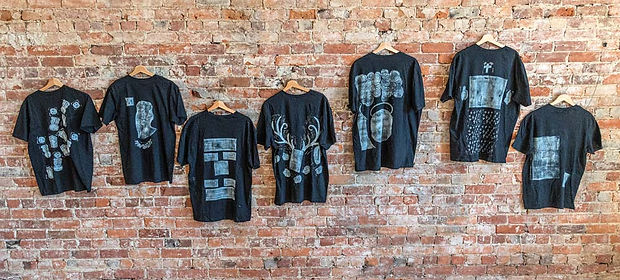
Those stories eventually became the Artemis Theory Collection.


"A lot of people think the Calls to Action are all about residential schools and payouts," Kendra says. "But there’s water, land, arts, child education, tons more... it's not like you can just check one off. There's 94 of them. Me, as one person, it took seven months working on this collection towards one call to action. It's ongoing. It takes effort. You can't just throw it around and expect it to get fixed."
From the beginning, she knew the work needed to be a collection."You can't say one thing and that's the experience of a people," she says.
Through linocut printmaking, Kendra found a way to express who she is while creating space for stories that need to be seen and heard. Her work is driven by the ongoing realities Indigenous people, and particularly Indigenous women, continue to face.
Not every conversation sparked by the collection has been easy. "When I launched the Monument shirt, everyone around me thought it was cool. But when I posted it publicly, there were polarizing views. It set me back a little bit. I wasn't prepared."
"This needed to come together as a collection."
The Monument design was inspired by the controversy surrounding Orillia's Samuel de Champlain statue. Kendra explains that this statue has been a point of contention for her community for decades. When the statue was temporarily removed by Parks Canada for refurbishment, some white Canadians immediately blamed Indigenous communities and accused them of trying to erase history, even though the statue had simply been taken down to be repaired. For some, Champlain represented an important Canadian figure. For many Indigenous people, however, the statue represented a colonial narrative of Indigenous subordination. The original layout depicted Champlain as the central figure, with two scenes below him: one of a missionary holding a cross above two Indigenous figures, and the other showing a fur trader with Indigenous figures at his feet.
When the statue of Champlain was returned, alone, some extremists saw it as a victory, even though the reason it was originally removed was simply to be maintained. After an activist from Rama First Nation spray-painted the statue base with “Rama said no”, the debate intensified further. “People jumped on that, it gave them an excuse to be nasty” says Kendra as she recalls watching online commenters ‘painting’ indigenous people as vandals, even though the act was done in the name of reclaiming a perspective that had been ignored. “I'm never going to say they did the right thing, or approached it in the best way, but they didn't spread any lies,” Kendra explains of the graffiti situation.
Kendra's design was inspired by seeing the statue later covered by a tarp in the rain on a dark cloudy day, which made it look like an apparition, “something from the past that had resurfaced and unsettled people.”


After selling five shirts before the design had even gone to print, Kendra posted the design online. It quickly sparked many of the same debates that had surrounded the statue and the subsequent spray painting incident. Indigenous responses were also divided: some worried the shirt could reinforce negative stereotypes of Indigenous people “as criminals and mischief makers,” while others praised Kendra for taking a bold stance on the incident. “It was almost enough that I considered pulling that shirt,” Kendra says. “But that was only for a second. At that point, I knew even more that it had to be part of the collection.” It was creating the tough conversations she wanted people to have.
"Everyone said, 'This is totally what you wanted.' People were talking. It stirred conversation."

For Kendra, that's the point: "In recovery they always say you have to talk about your experience, strength, and hope," she says.
This also reflects her understanding of the Medicine Wheel. "In our teachings, there are four parts of our selves, mind, body, heart, and spirit. You need to take care of each of those things. Art did that to me. It started to heal all the parts of me."
"That's what this collection is too.
These are my experiences as an Indigenous person. These are my strengths as an Indigenous person.
And my hope is that they will make a discussion."


Thank you, Kendra, for your bravery in sharing your story. Your courage inspires others and highlights the importance of openness and vulnerability. We appreciate your willingness to connect with us through your experiences.
Thank you, Sukhi, Arts Immersion Coordinator, for taking the time to sit down with Kendra and capturing her story.
Follow Kendra Danielle and the Artemis Theory Collection for updates.

Each design in the Artemis Theory Collection represents one of the Seven Grandfather Teachings while exploring a contemporary issue affecting Indigenous communities.
Truth - Monument asks viewers to reconsider whose histories our monuments honour.
Love - Tikanagan reflects on Indigenous child welfare and the lasting impacts of government policy.
Humility - Bright Shores explores how treatment systems can fail Indigenous people in recovery.
Bravery - Deer Lady honours a powerful protector who symbolizes justice, resilience, and the strength of Indigenous women.
Honesty - ECM confronts the legacy of residential schools.
Respect - Hungry Ghosts draws on the teachings of the Windigo and Hungry Ghosts as metaphors for greed, addiction, and exploitation.
Wisdom - Artemis Theory, a reflection on reconciliation itself, challenging performative gestures while calling for deeper understanding and change.